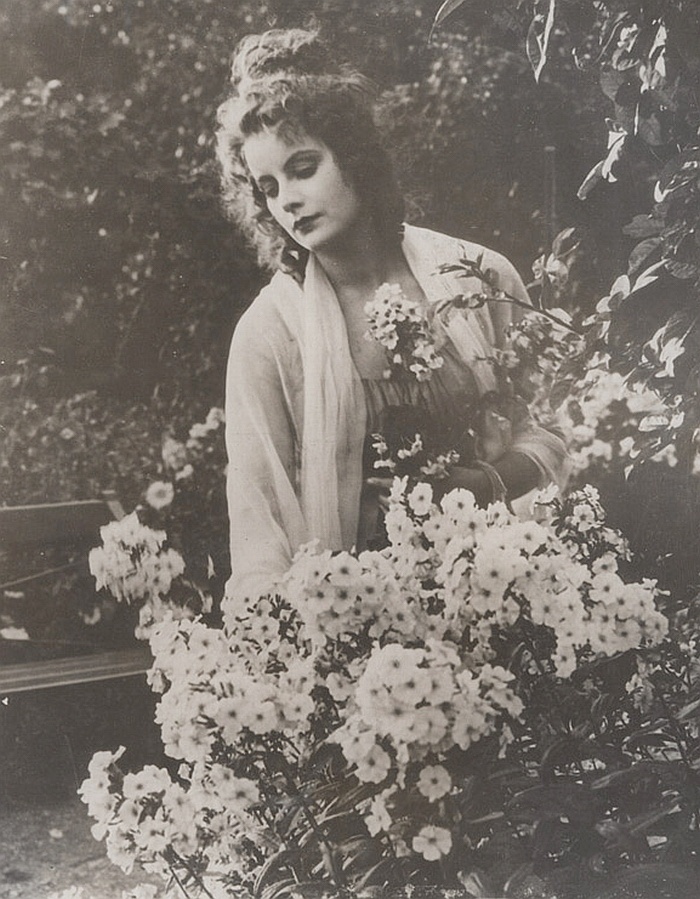
Short Interviews and More


Content

* Garbo's first interview (Sweden, Jan/Feb 1924)
* Garbo's first American interview

* Garbo's 'Picture Show' interview
* Garbo's 'Lektyr' interview
* Garbo's 15 minutes interview on Harby
* Garbo's shortest interview


Garbo's first interview (Sweden, Jan/Feb 1924)

In early 1924, while filming Gösta Berling Saga in Stockholm, Greta gave an interview to Inga Gaate,  for the Swedish magazine Filmjournalen.

Greta confessed that the work had been terrifically difficult. “It has been a Gethsemane,” she declared. But she was grateful to her director for being exceedingly patient with her. “Stiller is the most generous person in the world,” s he said. “You never get angry or sad no matter how much he bawls you out. He creates people and shapes them according to his will.”

According to Vera Schmiterlöw, after reading this interview, Stiller forbade his protégé to given any more interviews during production – or indeed any at all xclusive of his attendance.


Garbo's first American interview (USA 1925)

Garbo and Stiller arrived in New York late in the evening of July 5, 1925. Hubert Voight, the junior publicist of MGM, was assigned to meet them.  After some pictures were taken t hey settled into their hotel rooms at the Commodore.

Some days later, Voight had arranged for her to do an interview with Motion Picture magazine. Garbo got a cold that night and was in bed for several days. When W. Adolphe Roberts arrived at the Commodore, Voight took him upstairs to Greta's room.

“We knocked on the door, but she did not answer. We pounded. Still no answer,” the publicist said, “my heart was in my mouth. I was crazy about her and I thought of all sorts of things she might have done on account of some mood or other.”

Although Voight had only known Garbo a short time, he was already acquainted with her changing moods. When he opened the door, he saw Greta sitting calmly in bed – reading. "Hoo-bert ... Go avay and stay avay!”  she demanded. (Voight remembered her responding in English, though there is no evidence that she knew more than a few words at this time.)

The publicist got her to agree to do the interview from bed while he and Roberts remained in the other room and Kaj Gynt (Garbo's interpreter) nervously guarded the doorway.

“Miss Garbo says she adores America, but is it always as hot as this in summer?” Ms. Gynt told them. “She looks forward to her work in America – if she survives the heat – marvelous skyscrapers here – the world's best movies – but heat, heat, HEAT!”

It was the first time Voight experienced what he would call her 'I tank I go home now' attitude. “


Garbo's Picture Show interview (USA 1927)

Greta Garbo “When i love”

"Tell me," said my companion, "what kind of man will you eventually marry?" I looked at him. We were walking on the sands at Santa Monica, where Live. It was sunset, all fire and gold. The sea smelt good, and there was the little, cool breeze that I love. I did not want to think of marriage and men and love just then, so I said: "How should I know? I am very young, although sometimes I feel older than the rocks and I am never sure of my own thoughts from one day to the next."

I feel like Mona Lisa

It is so stupid to say in a moment what kind of man one will marry. I only know that I would like my man to be like a Viking of my own country, strong and big and handsome. I would prefer to be the wife of a man with a look of the sea about him, gusty and surging, but calm and enduring, too. I do not like fluttery men, lady-killing men, emotional men, men who remind me of jazz dance places and hotel lounges. When I say I am young, I mean in years. Sometimes, inside, I feel like Mona Lisa; I feel that I have done everything, known everything, seen everything, and that life has no secrets left.

Mauritz Stiller, who understands me, says that this is temperament. Mauritz Stiller is like a harbour in rough weather-just like that. He discovered me. I worked my heart out for him, and it was he who brought me to Hollywood. So far as I know, not one of my people, who are very old-they came up the valleys of Sweden long, long ago-ever trod the boards of any stage. If they could see me today, undoubtedly they would be astonished.

They were seafaring men, high in colour and high in courage, and they liked, I am sure, as I do, the feel of the wind in their hair. I like the wind of the sea in my hair better than anything else in the world. I love the sea; that is why I live out at Santa Monica all the time. I am always rather homesick for my own land, and I can get breaths of her now and then in the sea breezes.

Stockholm

In Stockholm, where I was born, I went to the dramatic school. We put on an Ibsen play. I was cast for a very small role. I was waiting in the wings for my cue, when I saw a strange shadow on the wall at the back of the boxes. It looked like the shadow of a giant. A girl crept up to me and breathed in my ear: "See, there is Mauritz Stiller!" I peered out, and saw a tall man with a very grave, strong face, standing in the door of the box.

But I was thinking so much about my little part that I was not awed by the sight of third great man. I forgot him, and played my little part. Next day he called me to his office. He looked long at me with his deep eyes and said nothing. I looked at him, and felt very, very young , and I just smiled. And presently he smiled, too, and said, just as if he were talking to himself:

"You will go far my child. You are half a woman and half a child and you don't understand yourself yet. I am going to try you in the ingénue lead in ‘Gosta Berling's Saga'."

The school was electrified. But, somehow, I was not thrilled, only very interested in Mauritz Stiller and in myself, and what I would make of this part.

Evidently I made something that pleased my friend, Stiller, for when he began to make pictures, he took me into his studio to work for him. We made our pictures in a little studio, not so big as one of the sets I play on in Hollywood. It's top was open. Sometimes it rained or snowed-and we have a lot of snow in Sweden; I love snow-and then we could not work.

We never hurried; sometimes we took six months to finish a picture. Hollywood would have been worried to death at our slowness, our deliberation. But we were very happy.

John Gilbert as Screen Lover

I told John Gilbert this one day. I remember, when he was taking me out in a boat to fish. He is full of a terrific vitality. In the days of old, in my country, he would undoubtedly have been a sea adventurer, and a great one, and sagas would have been sung about him. We made many love scenes together in Flesh and the Devil, and he would never have anyone on the set when we were doing the big scenes.

Everyone was shooed off. He makes a wonderful screen lover; there is an element force in him which is like a song in the wind. Our director said he had never seen such love scenes, and I was very pleased about that; for I do not want to be thought of as a vamp. A vamp does not love' or inspire love. Infatuation is not love. I am not a siren.

My Aventures in Hollywood

I have has some adventures since I cam to Hollywood. It was an adventure to me to go to the Montmartre Cafe with a man who scarcely understood my English, and I had listen hard to understand his English. It was an adventure to learn the Charleston, and to go to those gay beach clubs a Santa monica. I like solitude. I go to dances now and then, but I do not care to cut what they call a figure in social life.

Most of my leisure time I spend at my home in Santa Monica, where we have a little colony of Scandinavians. We have tall Lars Hansen here. He is like me. He does not talk much, and has eyes like the sea. And Stiller and Seastrom live out here, and we talk and walk on the silver sands. I like storms, the sweep of rain, water dripping from my lashes.

I like the sea: we understand one another. It is always yearning, sighing for something it cannot have; and so am I. I give my life to pictures here. I want my pictures to be good. I have no energy for anything else. People tire me when I am working so hard on the set, and so do parties. I like to come right out to sea, and feel the wind from the sea in my face . I like to walk in the rain, alone. I like to swim-alone. I dream and I rest.

Love

Love? Yes one day I shall love. I am not cold. But I am very young, only just past twenty. I cannot manage, like these wonderful American girls, to do so many things at once-pictures, society, love. If I make pictures, I make pictures. If I make love emotions for camera, I have none over for real life. Some day I shall leave the pictures and give all myself to love. This is how I see life.

One cannot divide one's soul and heart and mind. Pictures or love; one cannot divide one's allegiance. This is what I think. But, as I say, I am very young. Life is a great adventure, and one can never tell. But I do know when I love, I shall not waste my love in dancing haunts, in the Ambassador and the montmartre. I shall fly to a little cabin high up in the mountains.

It will have big trees about it, and there will be no other houses near. The sea will toss and sing below, and we shall be happy-as free and happy as my Viking ancestors.

Special thanks to Annie aka Garbo20


Garbo 'Lektyr' interview (Sweden, 1931)

In 1931 Garbo recalled her childhood in the Swedish magazine Lektyr:

On her family

It was eternally gray — those long winter's nights. My father would be sitting in a corner, scribbling figures on a newspaper. On the other side of the room my mother is repairing ragged old clothes, sighing. We children would be talking in very low voices, or just sitting silently. We are filled with anxiety, as if there is danger in the air. Such evenings are unforgettable for a sensitive girl.

Where we lived, all the houses and apartments looked alike, their ugliness matched by everything surrounding us. Even the grass gave LIP trying. Usually in May some greenery tried to grow amid the ugly wilderness. I watched it with tenderness and watered the few blades of grass each morning and night. But in spite of my care they languished and died. They died just as did the children in our forlorn neighborhood.

On her sister

My sister! My little sister — I called her that, in spite of the fact that she was two years older than me. She had always been so fresh, so beautiful. And suddenly, she was ill. It started very slowly, and then . . . I had hoped that she would come to America and join me. She had been in movies in Sweden a little, and I am sure she had a future in the movies.

On her childhood

I was always sad as a child, for as long as I can think back. I hated crowds of people, and used to sit in a corner by myself, just thinking. I did not want to play very much. I did some skating or played with snowballs, but most of all I wanted to be alone with myself. Although I was the youngest of the family, my parents always looked upon me as the oldest. I can hardly remember a time that I was ever very little, or as little as other children. I don't think anyone ever regarded me as a child.

Young as I was, I always had my own opinions and my brother and sister let me make the decisions for us all. It has been said that I was prematurely grown up. I was tall as a child but did not grow any more after the age of twelve. I cannot put a year to the time that my love for the theater first began. It seems as if I have always carried it inside me.

Already when I was very small and could still hardly talk I had a certain mania to paint — not on paper, as most children do, but on my own face.

Little Greta painted

With the aid of a small paintbox my father had given me I painted my lips and face, believing that this is what real actresses do. No one in my family could escape my paintbrush. Then I forced them, together with me, to perform big dramas, amid screams which would make any spectator doubt that I was in possession of my senses.

I never enjoyed playing with others, even with my sister and brother, but preferred to sit alone with my dolls and picture books, and I found my greatest pleasure in my childish dreams.  Unfortunately I am still the same now — finding it difficult to adjust to other people.

Schooldays

As for my schooldays, I lived in a constant state of fear, disliking every moment of it and especially two subjects: geography and mathematics. I could never understand how anyone could be interested in faraway places, or in trying to solve such ridiculous problems as how many liters of water could pass through a tap of such and such width in one hour and fifteen minutes.

I not only thought it was stupid to lose time with such questions, but to the astonishment of my teachers I even dared to say so out loud. The only subject I really liked was history, which filled me with all kinds of dreams. I read my schoolbooks on history just as if they were novels and often let my fantasy wander.

Her fantasy

According to my fancies I might shorten the life of a cruel king and replace him by a romantic knight, or reawaken an unhappy queen centuries after her death. When the history teacher asked me questions I started by giving the correct answers, but then would get carried away, spluttering forth with conjured-up visions of my own.

When the teacher stopped me and told me to start again from the beginning, I could no longer remember what I had said before and turned red. My embarrassment was taken as proof of my ignorance and I would get the lowest marks.

The death of her father

I was fourteen years old when my father died, after a long, lingering illness. He was only forty-eight. From that time there was only sobbing and moaning to be heard in our home. My brother and sister would not even try to control their grief, and I often had to ask them to be quiet. To my mind a great tragedy should be borne silently.

It seemed disgraceful to me to show it in front of all the neighbors by constant crying. My own sorrow was as deep as theirs, and for more than a year I cried myself to sleep every night. For a time after his death I was fighting an absurd urge to get up in the night and run to his grave to see that he had not been buried alive. Our lives were always ruled by extreme poverty.

Father's paltry wage was the only income we had to live on until his death. Now it became necessary for all of us to work. My brother and sister found jobs in various shops, earning a few kronor. I was still too young, and besides, my mother wanted me to stay at home with her. But we badly needed every penny, and soon afterward a friendly neighbor got me a job in one of the local barber shops.

The local barber shops

My work there consisted of lathering the men's faces, preparing them to be shaved by the barber. While he shaved one I would be putting soap on the next one's stubble. I soon conquered my early shyness and a certain feeling of degradation, and was not at all unhappy anymore, knowing that I did a good job. I was never as proud as of my first week's wages.


Garbo's 15 minutes interview on Harby (Sweden 1938)

15 Minutes

- and not bone single minute more - lasted the interview, Garbo gave Gnesta, a Swedish journalist. The interview was on her Swedish estate Harby were Greta often spend christmas holidays. She bought the property for her mother in 1936.

She told the journalist that she did not have any intention to play the leading role in Joan of Arc. Garbo said that she is rather interrested to play more cheerful film materials and there upon is looking out for such different material.

She also denies the rumor that it she would would like to make a film for an English studio in a historical film. Such an intention is not present, particularly since cos she will already return in January 1939 to Hollywood.

But she sais that there is some truth in the rumor that she would like to appear in an English stage production. The question, if she already decided for a more cheerful film material she let unanswered: it is too early to speak about it.


Garbo's shortest interview (France mid 1950s)

Her last interview appears to have been with the celebrated entertainment writer Paul Callan of the London Daily Mail during the Cannes Film Festival.

Meeting at the Hotel du Cap Eden Roc. Callan began "I wonder...", before Garbo cut in with "Why wonder?", and stalked off, making it one of the shortest interviews ever published. The newspaper gave it a double page spread.


Introduction


Documented Interviews and Conversations


Photoplay Interview 1927 (by Ruth Biery)
  
 
Shipboard Press Conference 1932
  
 
Shipboard Press Conference 1936
  
 
Garbo und Stokowski  Press Conference 1938
  
 
Shipboard Press Conference 1938


... nach oben

Free Hit Counter

© Copyright 2005 – www.GarboForever.com – Germany – TJ & John – The Webmasters